
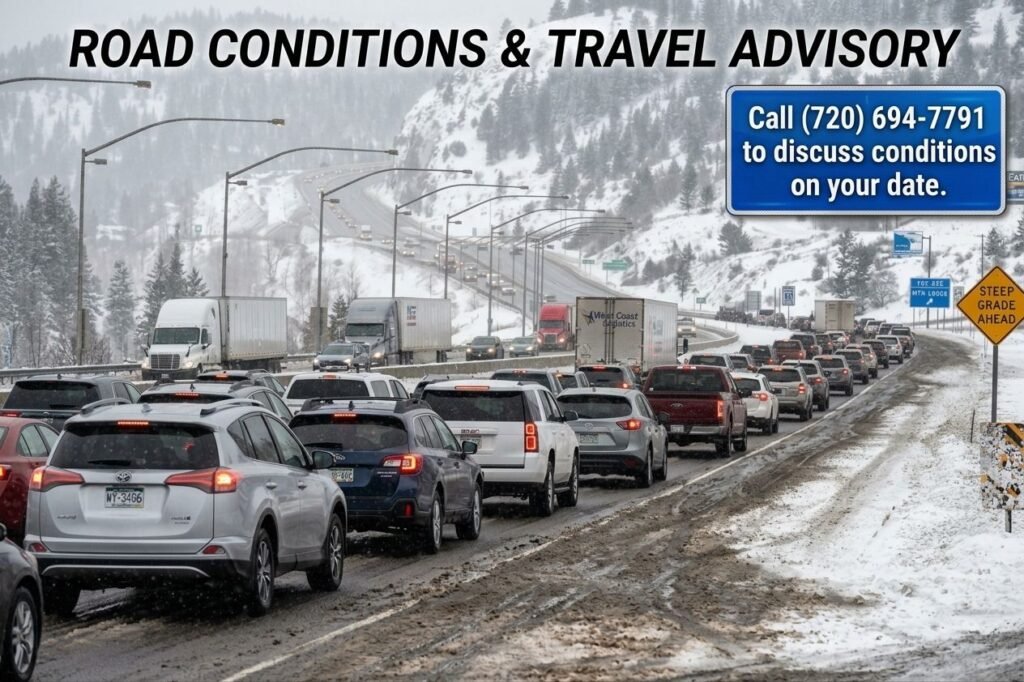
Ask anyone who drives the corridor regularly and they’ll tell you the same thing: the ski season first snow on I-70 produces the worst driving day of the entire winter. Not January. Not a Christmas blizzard. The first real storm, usually sometime in November, when a few thousand people who haven’t driven in snow since April all decide to go skiing on the same morning.
If you’d rather sit that one out, call (720) 694-7791.
Why the First Storm Is Different
Three things converge, and none of them is the snow itself.
Everyone goes at once. The first significant snowfall of the season is an event. Resorts post about it, social media amplifies it, and people who were planning to ski in December suddenly decide to ski this weekend. Demand that normally spreads across a month lands on one morning.
Nobody is equipped yet. Winter tyres go on in December for a lot of drivers. Chains live in the garage until someone needs them. The vehicle that handled last season fine is now a season older on tread it hasn’t been checked on.
Everyone has forgotten how. Snow driving is a skill that decays over seven months. Following distance, braking, what a steep grade feels like when the surface is packed — the first storm is when people rediscover all of it, simultaneously, at speed, on the same road.
What Actually Goes Wrong
It almost always starts with one vehicle. A car with inadequate tyres loses traction on a grade, stops at an angle across a lane, and the highway behind it stops too.
On I-70, that single incident compounds badly. The Eisenhower Tunnel at 11,158 feet and Vail Pass at 10,662 are the two places it tends to happen, and both are chokepoints with no alternative. A spin-out on Vail Pass doesn’t slow traffic — it holds it, sometimes for hours, while crews clear and ploughs get through.
Colorado State Patrol issued 586 chain-law violation citations between September 2025 and May 2026, with 522 of them on the I-70 corridor — in a season with historically low snowfall. A heavier first storm produces considerably more.
The Traction Law Is Already Active
This is the part that catches early-season drivers, because it’s counterintuitive.
Colorado’s traction law runs automatically on I-70 between Dotsero and Morrison from 1 September to 31 May — not when it snows, but the whole time. You need 4WD or AWD with at least 3/16-inch tread, or winter or M+S rated tyres with the same depth, or chains and an approved traction device. Two-wheel-drive vehicles are expected to carry chains or an equivalent through the season.
So on the first storm day, the law has been in force for two months and most of the people breaking it have no idea. Our traction law guide covers the requirements in full.
Timing a First-Storm Drive
| When | What you’ll find |
|---|---|
| Before 5:00 AM | Clearest window, ploughs still ahead of it |
| 5:00–7:00 AM | Busy but moving |
| 7:00–11:00 AM | Peak risk — volume and inexperience together |
| Mid-afternoon | Usually clearer, storm permitting |
| Day after the storm | Better snow, better roads, fewer people |
The last line is the genuinely useful one. The day after a storm is frequently the better ski day and reliably the better drive — the roads are cleared, the crowd has gone home, and the snow has settled. Chasing the storm itself is mostly ego.
Reading the Storm Before You Go
Check COtrip.org the night before and again before you leave. It carries live closures, active traction and chain restrictions by segment, and camera feeds — and a Code 16 chain law declaration appears there before anywhere else.
Watch overnight timing. A storm that clears by 4am gives ploughs a head start. One still falling at 7am means you’re driving in it alongside everyone else.
And be willing to abandon the plan. The genuinely experienced corridor drivers are the ones most comfortable saying the drive isn’t worth it today. Our I-70 ski traffic guide covers the normal weekly pattern that storms override.
When the Storm Is the Opening
Early-season storms carry extra weight this year, because the resorts still holding their dates are waiting for exactly that. Keystone and Arapahoe Basin both open as soon as conditions allow, with no more than a day’s notice — and the storm that triggers an opening is the storm that makes the drive hard.
If you’re planning to be there on day one, our first-to-open guide covers the race, and the transport plan should be ready before the announcement rather than after.
The Case for Not Driving It
On a normal day, a private transfer is a convenience. On the first storm day it’s a different proposition: a driver who runs this corridor several times a week through winter, in a vehicle that’s been traction-compliant since September, watching conditions before you’ve woken up.
The skill gap on a first-snow morning is wider than at any other point in the season — not because the road is harder, but because everyone else on it is out of practice. See our rates or call (720) 694-7791.
Frequently Asked Questions
Why is the first snow on I-70 so bad for traffic?
Everyone travels at once, few vehicles are equipped yet, and most drivers haven’t driven in snow since spring. Those three things together cause the spin-outs that close the road.
When does the traction law start?
1 September, automatically, on I-70 between Dotsero and Morrison — long before the first storm arrives.
What’s the safest time to drive during a storm?
Before 5am, or the day after. Between 7 and 11am is when volume and inexperience overlap.
Is the day after a storm better?
Usually, on both counts — cleared roads, fewer people, and settled snow on the mountain.
Do I need chains if I have all-wheel drive?
Not under the traction law if your tread meets 3/16 of an inch, but a chain law declaration during a severe storm requires chains or an approved device on every vehicle.
Can a transfer still run during a storm?
Usually, with compliant vehicles and experienced drivers — though nobody can drive through a closed road. Call (720) 694-7791 to discuss conditions on your date.