
Two things about the Colorado traction law surprise almost every visitor. The first is that it isn’t triggered by snow — on the I-70 mountain corridor it’s simply active, every day, from 1 September to 31 May, regardless of what the sky is doing. The second is that if you’re driving a front-wheel-drive rental, you’re now expected to carry chains.
Neither of those is new this winter, but both catch people out. If you’d rather not think about tyre tread at all, call (720) 694-7791.
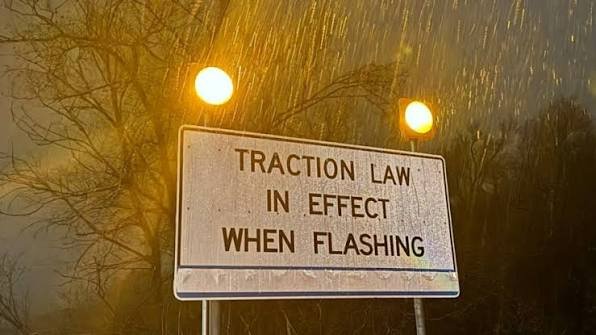
Where and When It Applies
The Traction Law runs automatically on I-70 between Dotsero at mile marker 133 and Morrison at mile marker 259 — a 126-mile stretch — from 1 September through 31 May each year. That covers Floyd Hill, Georgetown, the Eisenhower Tunnel and Vail Pass. In other words, the entire Denver-to-ski-country drive.
Outside that corridor and window, CDOT can activate it on any state highway when conditions require. In practice that regularly means US 285 toward Fairplay, US 40 over Berthoud Pass to Winter Park, US 6 over Loveland Pass, Highway 9 between Frisco and Fairplay, and all of US 550.
What the Colorado Traction Law Actually Requires
| Your vehicle | What you need |
|---|---|
| 4WD or AWD | At least 3/16-inch tread on all tyres |
| Winter-rated tyres | Mountain-snowflake symbol, 3/16-inch tread |
| Mud and snow tyres | M+S marking, 3/16-inch tread |
| Any vehicle | Chains or an approved traction device |
| 2WD, including front-wheel drive | Must carry chains or an approved device |
Three-sixteenths of an inch is the figure to remember. It’s more than the legal minimum for ordinary driving, which means a set of tyres that passes inspection perfectly well can still put you out of compliance on I-70.
The 2WD requirement is the one worth flagging to anyone renting a car. Under recent legislation, two-wheel-drive vehicles on the corridor are expected to carry chains or an approved alternative traction device such as an AutoSock through the season. A standard rental sedan does not come with those.

Code 15 and Code 16
CDOT uses two escalating levels, and it helps to know which one you’re hearing about.
Code 15 is the Traction Law — the one described above, and the default state of I-70 for nine months of the year.
Code 16 is the Passenger Vehicle Chain Law, activated during severe storms. At that point every vehicle on the road must have chains or an approved device fitted, regardless of drive type or tyres. It’s the last measure before the highway closes entirely.
Restrictions can change within the hour in either direction. CDOT posts them by segment on COtrip.org and on the overhead message signs along the corridor.
The Fines, and the Bigger Number
CDOT puts the penalty for noncompliance at a $50 fine plus a $17 surcharge. Other published figures run considerably higher, and a violation that results in a blocked roadway carries a substantially larger penalty than a straightforward equipment citation.
But the fine isn’t really the point. Colorado State Patrol issued 586 chain-law violation citations between 1 September 2025 and 31 May 2026, and 522 of those were on the I-70 corridor — in a winter with historically low snowfall.
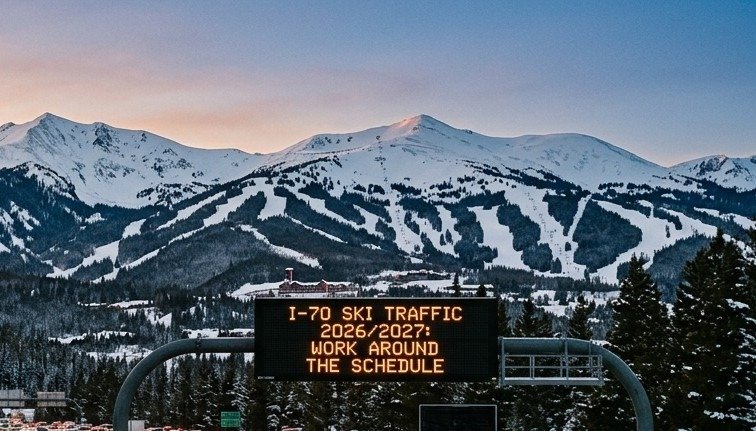
The reason the law exists is the second-order effect. A vehicle on bald tyres doesn’t just get stuck; it spins, it crosses lanes, and it stops a mountain highway for everyone behind it. Most of the multi-hour I-70 closures that ruin a Sunday start exactly that way. Our guide to I-70 ski traffic covers what those closures do to the corridor.
The Rental Car Problem
Rental companies are required to notify customers about traction law requirements, but a notification is not a set of chains, and the vehicle you’re handed at DIA is whatever was on the lot.
So the sequence that catches visitors goes like this: book the cheapest class, land in Denver, drive west, and discover somewhere around Georgetown that the message boards are lit and your front-wheel-drive sedan has nothing in the boot. The options at that point are turning around, buying chains at a gas station at a markup, or continuing and hoping.
If you’re renting for a ski trip, either pay for the AWD class or accept that you’ll need to buy traction devices before you leave the metro. Our comparison of car service versus a rental car puts the real cost of that upgrade in context.
What to Check Before You Drive
Measure your tread properly rather than eyeballing it — 3/16 of an inch is roughly the distance to the top of Lincoln’s head on a penny inserted upside down, and most people overestimate what they have.
Look at the sidewall for the M+S marking or the mountain-snowflake symbol. All-season tyres aren’t automatically compliant.
Check COtrip before you leave, not at Idaho Springs. Restrictions appear there first.
And if you’re carrying chains, know how to fit them before you’re kneeling in a snowbank on Vail Pass in the dark. Practice once in a driveway.
Or Skip It Entirely
Commercial operators running this corridor deal with the traction law as routine — compliant vehicles, drivers who fit devices when required, and someone watching CDOT before you’ve had breakfast. It’s the one genuine argument for a transfer over a rental that has nothing to do with comfort.
See our rates or call (720) 694-7791.

Frequently Asked Questions
When is the Colorado traction law in effect?
Automatically on I-70 between Dotsero and Morrison from 1 September through 31 May, regardless of weather, and on other state highways when CDOT activates it.
Do I need 4WD to drive I-70 in winter?
Not necessarily. You need 4WD or AWD with 3/16-inch tread, or winter or M+S rated tyres with the same tread depth, or chains and an approved traction device.
Do front-wheel-drive cars need chains?
Two-wheel-drive vehicles, including front-wheel drive, are expected to carry chains or an approved alternative traction device on the corridor through the season.
What is the fine for a traction law violation?
CDOT lists a $50 fine plus a $17 surcharge. Blocking the roadway because of inadequate equipment carries a substantially higher penalty.
What is the difference between Code 15 and Code 16?
Code 15 is the Traction Law. Code 16 is the Chain Law, activated in severe storms, requiring chains or an approved device on every vehicle.
Are rental cars traction law compliant?
Not automatically. Companies must notify you of the requirements, but a standard rental won’t include chains — call (720) 694-7791 if you’d rather not deal with it.