
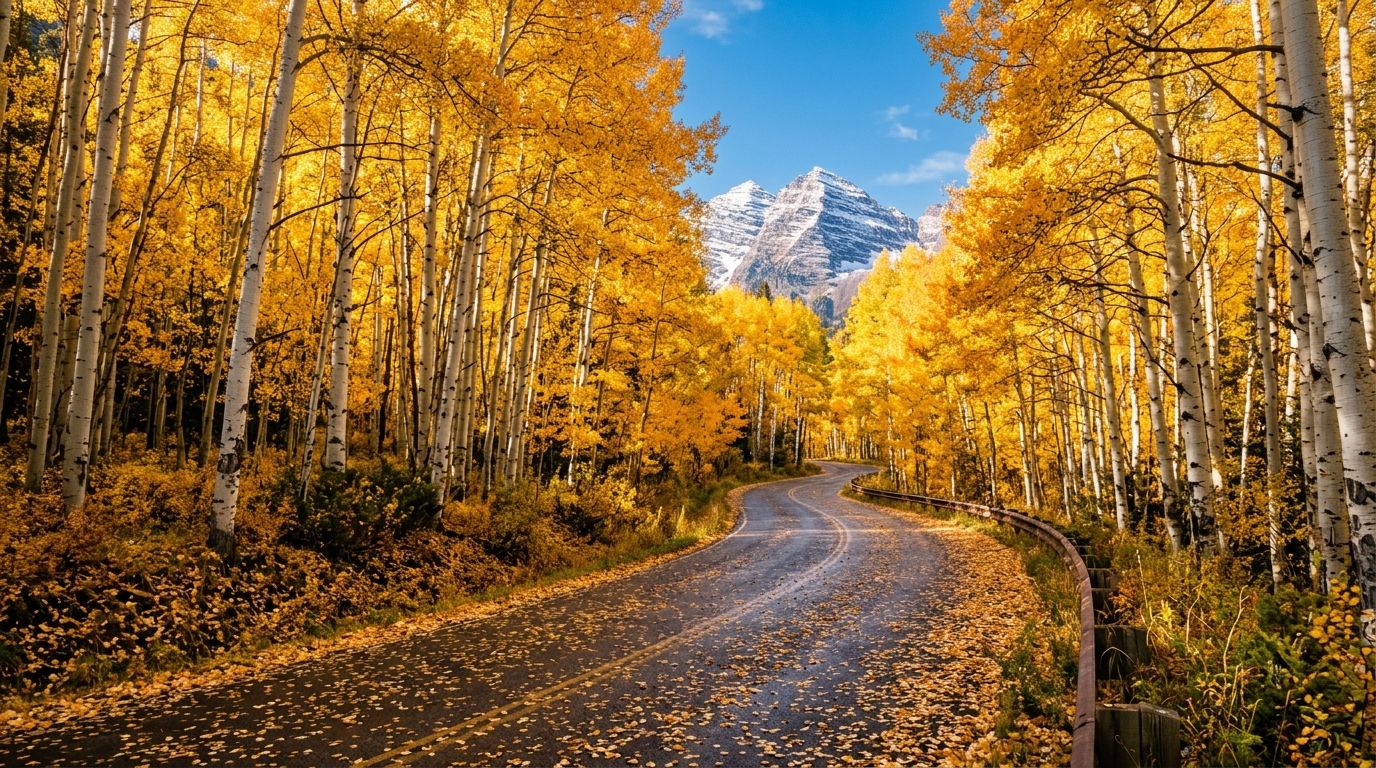
Colorado’s aspens peak in a rolling wave from mid-September to mid-October, moving downhill as the season progresses. High country above 10,000 feet typically peaks in the third week of September. The 8,000 to 10,000 foot band follows in the last week of September into the first days of October. Foothills and lower valleys hold on until the first two weeks of October. If you have one weekend to spend, the final weekend of September is the safest bet for hitting gold somewhere in the state.
Why Colorado’s timing is more predictable than most places
Aspen color change is driven primarily by photoperiod — the shortening of daylight hours — rather than by temperature. That’s why the calendar repeats itself so reliably year after year, and why a warm September doesn’t push peak color back by weeks the way many people expect.
Weather still matters, but it affects quality and duration rather than timing. A dry summer can produce duller color and earlier leaf drop. A hard early freeze or a strong wind event can strip a grove in a couple of days. What weather rarely does is move peak week significantly.
The practical implication: you can plan a Colorado fall colors trip months in advance with reasonable confidence, then fine-tune the specific destination in the final week.
Peak color calendar by elevation
| Elevation | Typical peak window | Representative locations |
|---|---|---|
| Above 10,000 ft | Sept 15–25 | Independence Pass, Kebler Pass, Guanella Pass summit |
| 9,000–10,000 ft | Sept 22 – Oct 2 | Kenosha Pass, Boreas Pass, Vail and Breckenridge area |
| 8,000–9,000 ft | Sept 28 – Oct 8 | Peak to Peak Highway, Steamboat Springs, Estes Park |
| Below 8,000 ft | Oct 5–18 | Golden, Boulder foothills, lower Front Range canyons |
Cottonwoods, which line the lower river valleys, turn last — often deep into October, well after the aspens have finished.
The best fall color drives from Denver
Kenosha Pass — the easiest big payoff
About 70 miles southwest of Denver on US 285, Kenosha Pass sits at roughly 10,000 feet and delivers dense aspen stands right at the roadside. It’s the most accessible serious color from Denver, which is exactly why it’s crowded — the parking lots overflow by mid-morning on peak weekends. Arrive before 8am or go on a weekday.
Guanella Pass — dramatic and steep
Running between Georgetown and Grant, Guanella Pass climbs to about 11,600 feet with sweeping views toward Mount Blue Sky. The aspen groves on the Georgetown side are exceptional. The road is paved but narrow and winding, with limited pullouts.
Kebler Pass — the largest aspen grove in North America
Near Crested Butte, Kebler Pass runs through what’s widely considered the largest aspen grove on the continent. It’s a genuine spectacle and worth the roughly four-hour drive from Denver. The road is graded dirt and closes with the first significant snow, so it’s an earlier-season target — usually the third week of September.
Independence Pass — high, exposed, and time-limited
The route between Twin Lakes and Aspen crosses 12,095 feet with color layered below the treeline. Note that Independence Pass closes for the winter, typically in early November, and can shut temporarily after any early storm.
Peak to Peak Highway — the low-commitment option
Running from Estes Park through Nederland to Black Hawk, this is the closest quality foliage drive to the Front Range. It peaks later than the high passes, making it a good early-October choice when the high country is already bare.
Boreas Pass — quiet by comparison
Above Breckenridge, this former railroad grade climbs gently to 11,481 feet on a well-maintained dirt road. It sees a fraction of Kenosha’s traffic and pairs naturally with a Breckenridge visit — see our guide to things to do in Breckenridge.
How to check conditions before you drive
Don’t rely on last year’s photos or a generic date. In the week before your trip:
- Check the Colorado Tourism Office’s fall color report, updated through the season.
- Search recent geotagged photos for your target location — user posts from the past 48 hours are the most reliable signal available.
- Check CDOT for road status, especially on high passes after any storm.
- Have a backup destination roughly 1,500 feet lower in elevation. If your first choice has dropped, the lower option is often at peak.
Practical planning notes
Traffic is the real constraint. On peak weekends, I-70 westbound out of Denver backs up badly from mid-morning, and the eastbound return between 2pm and 7pm on Sunday is reliably worse. Leaving Denver before 7am changes the entire character of the day.
Parking is limited and enforced. The popular trailheads at Kenosha and Guanella fill early, and roadside parking is restricted in many stretches.
Weather at altitude is not Denver weather. Late September at 11,000 feet can mean snow, sustained wind, and temperatures 25 degrees below what you left at home. Bring layers regardless of the forecast in town.
Dirt roads matter. Kebler and Boreas are unpaved. They’re manageable in a standard vehicle in dry conditions and considerably less so after rain or early snow.
Seeing the colors without doing the driving
These are winding mountain roads with steep drop-offs, heavy holiday traffic, and drivers stopping unpredictably for photographs. A private car with a chauffeur who drives these passes routinely turns the day into something you actually get to look at rather than navigate — and it removes the parking problem entirely, since you’re dropped at viewpoints and collected rather than circling for a space.
If you’d like to plan a fall color day trip from Denver, get in touch with our team or book a private transfer. For more Colorado destinations, browse our guide to places to visit in Denver.