
A Denver airport car service is a pre-booked private vehicle with a professional chauffeur that meets you at Denver International Airport and takes you directly to your destination — no shared stops, no surge pricing, and no waiting in a queue. For most travelers it costs between $95 and $180 for a downtown Denver transfer, and between $350 and $700 for mountain resort destinations, quoted as a flat rate per vehicle rather than per person.
This guide covers what you actually get, how the pickup works at DIA, how the cost compares to your alternatives, and when a car service is the wrong choice.
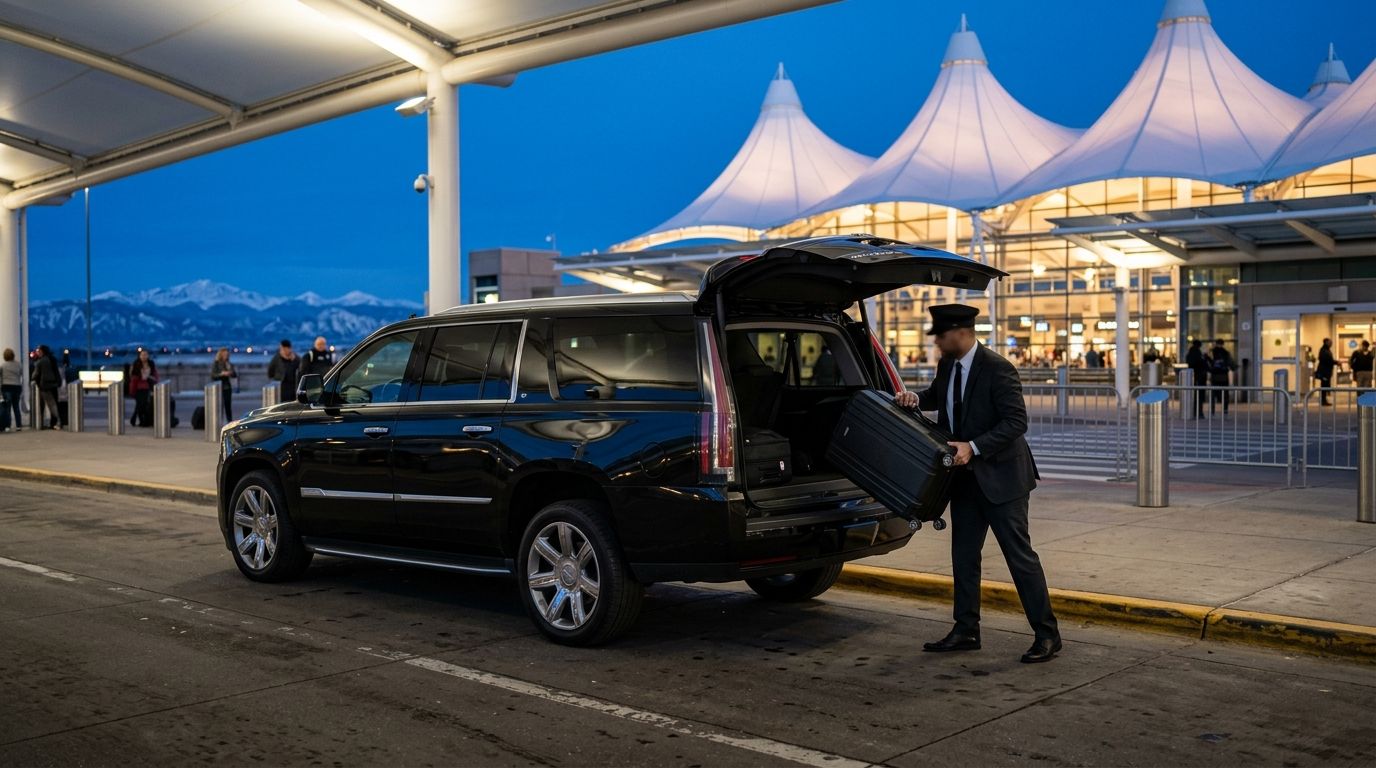
Denver airport transportation options compared
DIA sits roughly 25 miles northeast of downtown Denver, connected by a single access road — Peña Boulevard. That distance is the reason ground transportation from DIA costs more than it does at most US airports, and it’s why the option you choose matters more here than it would in Chicago or Atlanta.
| Option | Typical cost to downtown | Travel time | Best for |
|---|---|---|---|
| Private car service | $95–$180 flat, per vehicle | 35–45 min | Groups, luggage, late arrivals, mountain onward travel |
| Rideshare (UberX / Lyft) | $45–$130, surges heavily | 35–45 min | Solo travelers, light luggage, flexible timing |
| A Line commuter rail | Around $10 per person | 37 min to Union Station | Budget solo travel, downtown-only destinations |
| Shared shuttle | Per-person pricing | 60–120 min with stops | Solo budget travel to fixed hotel routes |
| Rental car | Daily rate + parking + fuel | 45+ min including counter | Multi-day trips with lots of independent driving |
Where the flat-rate math actually favors a car service
The single biggest misunderstanding about airport car service is that it’s a luxury upgrade. For one person with a carry-on, it usually is. For four people with checked bags, it frequently isn’t — because a car service quotes per vehicle, while shuttles and rideshare either quote per person or require a larger, pricier vehicle class.
Run the arithmetic for your own group before you assume:
- 1 traveler, downtown: rideshare or the A Line almost always wins on cost.
- 2 travelers, downtown, off-peak: genuinely close. Rideshare edges it unless there’s a surge.
- 4+ travelers with checked bags: car service is usually competitive or cheaper, because you’d need an UberXL or two separate cars anyway.
- Any group heading to the mountains: car service wins clearly. Rideshare drivers frequently decline or cancel long mountain trips, and rideshare has no obligation to complete one.
- Arrivals after 11pm or during a snow event: car service wins on reliability, which is worth more than the price difference at that hour.
We break the numbers down further in our guide to how much a limo costs in Denver, and you can see current pricing on our rates page.
How pickup works at Denver International Airport
DIA operates a single main terminal — the Jeppesen Terminal — with three concourses (A, B, C) connected by an underground train. Regardless of which concourse you land at, you’ll take the train to the terminal and collect any checked luggage there.
Pre-arranged commercial vehicles like car services do not pick up at the same curb as rideshare or taxis. DIA assigns commercial ground transportation to designated islands on the terminal’s upper level, and the exact island varies by vehicle class. Your chauffeur will text you the specific door number and island once you land — this is standard practice, and you should be suspicious of any operator who can’t tell you where they’ll be.
Curbside pickup vs meet-and-greet
You have two choices, and they suit different trips:
- Curbside pickup — you text your driver when you have your bags, walk out to the assigned door, and the vehicle is there. Faster, and included at no extra cost with most operators.
- Meet-and-greet — your chauffeur waits inside at baggage claim with a name sign, helps with luggage, and walks you out. Worth it for elderly travelers, families with small children, first-time visitors, or international arrivals.
Flight tracking: the feature that actually matters
Denver has some of the most disruption-prone weather of any major US hub. Spring upslope snow, summer afternoon thunderstorms, and winter storms all produce delays here regularly.
A professional car service monitors your flight number in real time and shifts the pickup automatically. If you land 90 minutes late, the driver arrives 90 minutes later — no rebooking, no additional charge, no scramble. Confirm this before booking, because not every operator offers it and some charge for the wait time.
Flight tracking only works if you supply your flight number at booking. If you’re connecting or your flight number changes, notify your operator directly.
Groups, luggage, and ski gear
Luggage capacity is where airport transfers most often go wrong, and it’s rarely discussed until the bags won’t fit.
A full-size SUV like a Suburban or Yukon XL comfortably handles four passengers with four large checked bags. Push it to six passengers and the third row eats most of the cargo space — you’re then limited to carry-ons or roughly two large bags. Ski and snowboard bags change the calculation entirely: they’re long, rigid, and don’t compress.
The practical rule: if you have more than one bag per person, or any oversized gear, tell your operator at booking so they can size the vehicle correctly. A Sprinter or high-roof van solves the problem for groups of seven or more. Sorting this in advance costs nothing; sorting it at the curb at 11pm costs you a second vehicle.
Onward travel to the mountains
A large share of DIA arrivals aren’t staying in Denver at all — they’re heading up I-70 to Vail, Breckenridge, Keystone, Beaver Creek, Copper Mountain, Winter Park, Aspen, or Steamboat Springs.
These transfers are a different category of trip. They run two to four hours, cross mountain passes above 10,000 feet, and in winter fall under Colorado’s traction law, which requires adequate tires or chains on I-70 during declared conditions. Rideshare is unreliable for these routes. Rental cars put an unfamiliar driver on a snow-packed mountain highway after a long flight.
If your trip involves the mountains, book the transfer at the same time you book your flights — mountain capacity sells out on ski-season weekends and holidays well in advance.
When a car service isn’t the right call
Being straightforward about this is more useful than a sales pitch. Skip the car service if:
- You’re traveling solo to downtown with light luggage and no time pressure — the A Line is faster and dramatically cheaper.
- Your schedule is genuinely undecided. Car service requires a booked pickup time; rideshare doesn’t.
- You need a vehicle for the duration of your trip and will be driving daily to scattered destinations.
How to book Denver airport transportation
- Book early. 48 hours minimum for standard transfers; 7–14 days for ski-season weekends and holidays. Our post on the best time to book airport transportation in Denver covers the timing in detail.
- Provide your flight number so tracking can be applied.
- Declare your luggage honestly, including golf clubs, skis, strollers, and car seats.
- Confirm what’s included — gratuity, tolls, wait time, and child seats vary by operator.
- Check the cancellation window before you pay.

You can reserve your DIA transfer online or call our dispatch directly. If you’re heading in the other direction, our guide on how early to leave for Denver airport covers departure timing.