
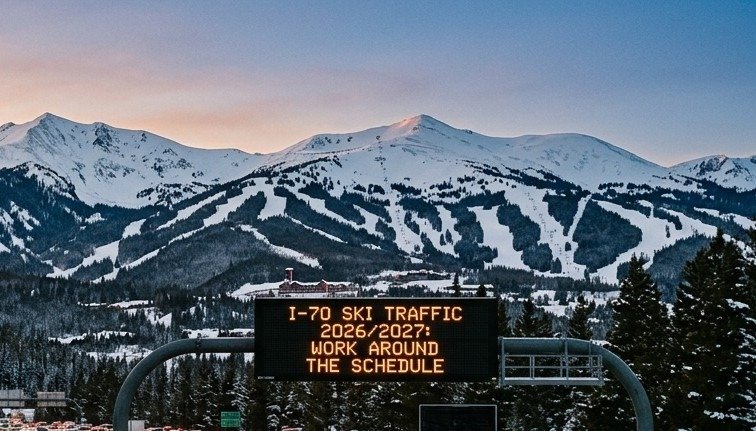
I-70 ski traffic in 2026/2027 will do what it does every year, which is the genuinely useful thing about it. Six million-odd people live on the Front Range, roughly a dozen major resorts sit west of Denver, and there is one road. That’s not a problem anyone is solving — but it is a problem that repeats itself on a schedule, and a schedule can be worked around.
Or you can let someone else drive it: (720) 694-7791.
The Two Chokepoints
Almost every I-70 delay traces back to one of two places.
The Eisenhower Tunnel sits at 11,158 feet and is the highest vehicular tunnel in the United States. Every eastbound vehicle from Summit County, Vail, Copper and everything beyond funnels through the same bore. When traffic exceeds capacity, or when there’s an incident inside, queues build back for miles toward Silverthorne. When it closes entirely, the alternative is Loveland Pass — higher, slower, exposed, and closed to certain vehicles.
Vail Pass at 10,662 feet is the other. It’s a sustained climb with a steep descent, it catches snow early and often, and a single spun-out vehicle can hold a lane for an hour.
Everything else — Idaho Springs, the Floyd Hill stretch, the final run into Denver — is congestion rather than constraint. The passes and the tunnel are where the hours disappear.
The Weekly Pattern
| When | Direction | Severity |
|---|---|---|
| Fri 2pm–8pm | Westbound | Heavy — weekend exodus |
| Sat 7am–11am | Westbound | Heaviest morning of the week |
| Sat 3pm–6pm | Eastbound | Moderate — day-trippers home |
| Sun 7am–10am | Westbound | Moderate |
| Sun 11am–7pm | Eastbound | Worst window of the entire week |
| Tue–Thu, any hour | Either | Light |
Sunday afternoon eastbound is the one to internalise. It’s every weekend visitor leaving at once, converging on the tunnel from four directions, and it turns a two-hour drive into five with some regularity.
I-70 Ski Traffic and the Hours That Actually Work
Leave Denver before 6am on a Saturday and you’ll have a clear run — the road is genuinely empty and you’ll be parking while everyone else is still on the approach. That single hour of discomfort buys back two hours of sitting.
Coming home, before 11am or after 7pm on a Sunday. Between those, you’re in it. Plenty of people now stay for dinner in Frisco or Idaho Springs specifically to let the wave pass, which costs an evening but saves the same amount of time and considerably more patience.
Midweek, none of this applies. Tuesday through Thursday the corridor drives the way the mileage suggests it should.

What Makes a Normal Day Worse
Storms are the obvious one, and they cut both ways: the snow that makes the skiing worth the drive is the snow that makes the drive hard.
Holiday weekends stack an extra day of traffic onto the pattern — MLK and Presidents’ Day both turn a Sunday problem into a Monday one. Christmas week suspends the pattern entirely in favour of sustained heavy traffic from 20 December to 3 January.
And opening weekends compress demand into single days. This season Breckenridge and Copper both open 6 November and Vail follows on the 13th — three openings in eight days, all on the same stretch of road. Our opening weekend guide covers that calendar.
Traction Law: The Thing That Causes the Backup
Colorado enforces traction requirements on I-70 during declared winter conditions — adequate tyre tread and all-wheel or four-wheel drive, or chains and approved traction devices. Fines apply, and they increase substantially if an unequipped vehicle blocks the highway.
That last clause matters more than the fine. Most of the multi-hour closures on this road start with a single vehicle that shouldn’t have been on it, stopped sideways on a grade. Visitors in rental cars booked on price are disproportionately represented in that statistic.
Check CDOT’s COTrip before any mountain drive — it carries live closures, restrictions and camera feeds, and it’s the first place a traction law declaration appears.
Routes That Avoid the Worst of It
Winter Park is the notable exception on the corridor. It’s reached via US 40 over Berthoud Pass rather than through the tunnel, which sidesteps the Sunday jam almost entirely — a real advantage that our Winter Park transfer guide covers in detail.
Loveland Pass is the tunnel’s alternative rather than a route in its own right. Useful when the tunnel backs up, unreliable as a plan, since it closes for avalanche control and is prohibited to some vehicles.
Or Simply Don’t Drive It
The honest case for a private transfer on this corridor isn’t comfort. It’s that the driver does this route several times a week through the winter, knows where the queues form and when, runs a traction-compliant vehicle as standard, and is watching CDOT before you’ve had breakfast.
Sitting in a Sunday tunnel queue is unpleasant. Sitting in one at the wheel, after a full ski day, with a flight to catch, is a different kind of unpleasant. See our rates or call (720) 694-7791.

Frequently Asked Questions
What is the worst time for I-70 ski traffic?
Sunday afternoon eastbound, roughly 11am to 7pm. Saturday morning westbound between 7am and 11am is the busiest of the other direction.
What is the best time to drive to the mountains?
Before 6am on a weekend, or any time Tuesday through Thursday. Coming home, before 11am or after 7pm on Sunday.
Why does the Eisenhower Tunnel back up?
Every eastbound vehicle from Summit County and beyond passes through the same bore. Volume or an incident inside creates queues that build back for miles.
Which resort avoids I-70 traffic?
Winter Park, reached over Berthoud Pass on US 40 rather than through the tunnel.
Do I need 4WD on I-70 in winter?
Colorado’s traction law requires adequate tyres or AWD/4WD during declared conditions, with higher fines if an unequipped vehicle blocks the road.
Can a private transfer avoid the traffic?
Not avoid it, but time it and route around it where possible — and the driving isn’t yours. Call (720) 694-7791.